The question
My final project in an MA in Communicating Complexity at Central Saint Martins, UAL begins with a question: How does friction amplify interpolation? Anchored in a sub-question — how does working through friction in d3.interpolate1 develop data visualisation expertise when automation removes the need to feel interpolation?
Interpolation here means more than its mathematical definition. It is the full space of navigation between two states — what happens between them, and who is present for it. That is where the research lives.
I work in data visualisation. I've watched the tools absorb decisions I used to make. And I started wondering what gets lost when that happens.
In 1966 John Cage asked for a computer that isn't labour-saving but which increases the work for us to do — one that turns us not 'on' but into artists.2 That's the principle behind this research.
The video
The video essay was a required submission alongside the written work. It follows the lineage from John Cage's 1966 warning, through Mike Bostock's d3.js, to Vera Molnár's lifetime inside the interpolation. The argument: expertise lives in friction. When the tools smooth that friction away, the practitioner is severed from the layer where understanding forms.
The middle
Every animated chart, every data visualisation that moves smoothly from one state to another is doing something called interpolation — calculating all the in-between values as data transforms. The ramp below shows four paths between the same two colours. Same start. Same end. Four completely different middles — depending on which colour space you move through.
RGB — d3.interpolateRgb("red", "blue")
The dominant platforms hide it completely. Data goes in. Visualisation comes out. The practitioner makes no decision about what happens in between.
Understanding doesn't form at the endpoints. It forms in the middle — in the felt consequences of moving through those in-between states. When that movement is automated away, so is the learning that would have happened inside it.
This research puts the practitioner back into the middle.
Twenty-five people
Twenty-five people. One continuous line, non-dominant hand, across nine axes — no going back. Each axis asked for a position. No pole is wrong. Even the centre is a stance.
Then the plotter drew its own version directly over their marks. Two interpolations, one sheet. The hand-drawn line and the machine's reconstruction side by side — not competing, just present.
The full sessions, all twenty-five sheets, and the apparatus that produced them are in data.
The gap
The gap between the two lines is the data. Not the lines themselves — the distance between them. Each participant's gap is different. None predictable. The dataset shows not a shared preference but a shared condition: everyone has a gap, and everyone's gap is their own.
A cluster emerged that wasn't planned for. Five participants on the same afternoon, all from fine art backgrounds. Their lines were the most spatially adventurous, the most willing to use the whole field. Arts training does something to range that data training doesn't.
All the research visualisations, the outliers are gathered in protocol.
25 participants — hand lines in purple, machine lines in black. Hover to identify.
1+1=3
Tufte after Albers: 1+1=3. Two things on the same surface produce a third — the gap between them. The gap isn't empty. It's the finding.
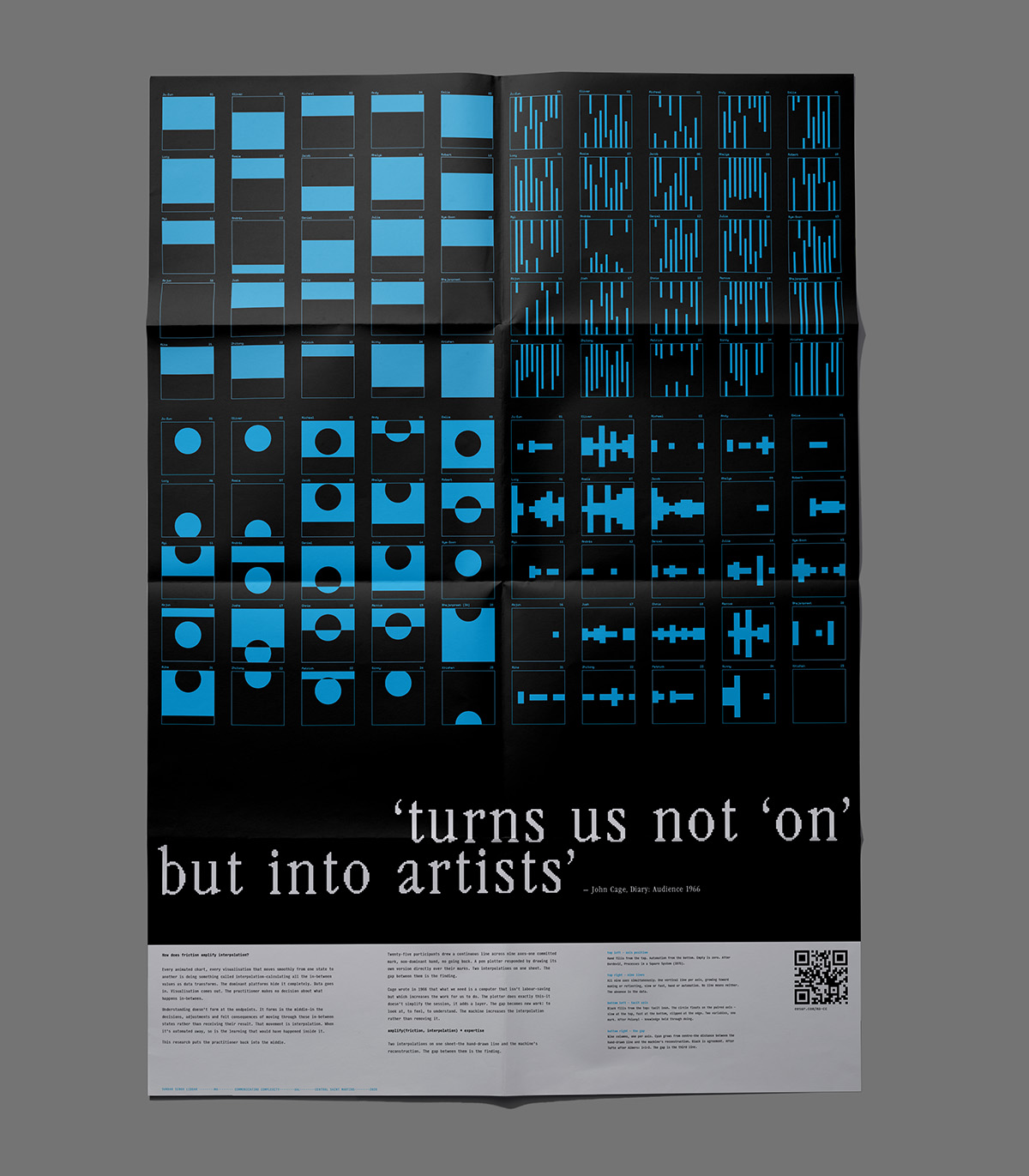
Twenty-five gaps. One per participant. Held in a 5×5 square system drawn from Đorđević's Processes in a Square System, 19753 — found in the CSM library after the visual language had already taken its form. Black is agreement. The absence of black is the gap.
Friction
Friction puts the middle back. Not as obstacle — as amplifier. The plotter increases the work rather than reducing it. The gap becomes new work: to look at, to feel, to understand.
Polanyi said we know more than we can tell.4 Schön said we reflect in action.5 Strati said the body is an instrument of understanding. The twenty-five sessions showed all three — in the marks, in the gaps, in the moments where hand and machine disagreed.
"Friction is a lively sensation underlying our humanness, sparking human connection." — Luna Maurer & Roel Wouters6
These practitioners work across different fields. Different methods, same refusal: don't smooth away the work. Albers7 taught you to feel colour relationships rather than specify them. Molnár8 kept her personal selection — agency inside the system. Riley9 made perception itself the material. Concrete poets10 marked language directly onto tape, bypassing the apparatus of print. Lieberman11 makes coding visible as performance rather than output.
They kept their hands on the interpolation. That positioning runs through every decision in this research — the non-dominant hand, the plotter response, the gap as finding rather than error.
The poster
The poster was submitted to the Poster as Catalyst open call, May 2026. It carries the Cage quote, the formula, and the finding. If you arrived here from the poster — this site shares some of what's behind it.
The close
Coming to the final outputs has made me reflect on what this project has actually given me. Not what I've produced. What I've learned about how I make.
Cage again. He's helped me out a lot. The agency move I didn't see until the close: it isn't just the practitioner who has to stay inside the middle. It's everyone who meets the work. The viewer has the same privilege. The connecting is theirs, not mine. Molnár understood this for sixty years. My life is squares, triangles, lines. She named the material and stepped back. Not absent — unobtrusive. The constraint was hers. The meaning was never hers to give.
That's where I've landed. The square system, the gap, the two lines on the sheet — I made the conditions. I didn't make the bridge. Whatever someone takes from meeting the 25 artefacts at degree show — 25 squares, 25 journeys — that's theirs. The work widened at the end, which I didn't expect. It started as a question about practitioners and interpolation. It ends as a stance about making — about what you owe the person who comes next. You owe them the gap. Not the explanation of it. By designing the friction rather than the artefact, something shifts in what it means to be a designer. I'm still working out what to call that.
This project gave me interpolation. Not as a technical term — as a way of being in the making. The privilege of staying in the middle. Of not rushing to the destination. The end comes to you. The hand arrives. You don't chase it. I will stay with interpolation. I will explore friction to amplify it.
And Cage's line lands differently now. There are no aesthetic emergencies. The work speaks its language to the language of the listener. I feel I'm in both and neither. That's where I want to stay.